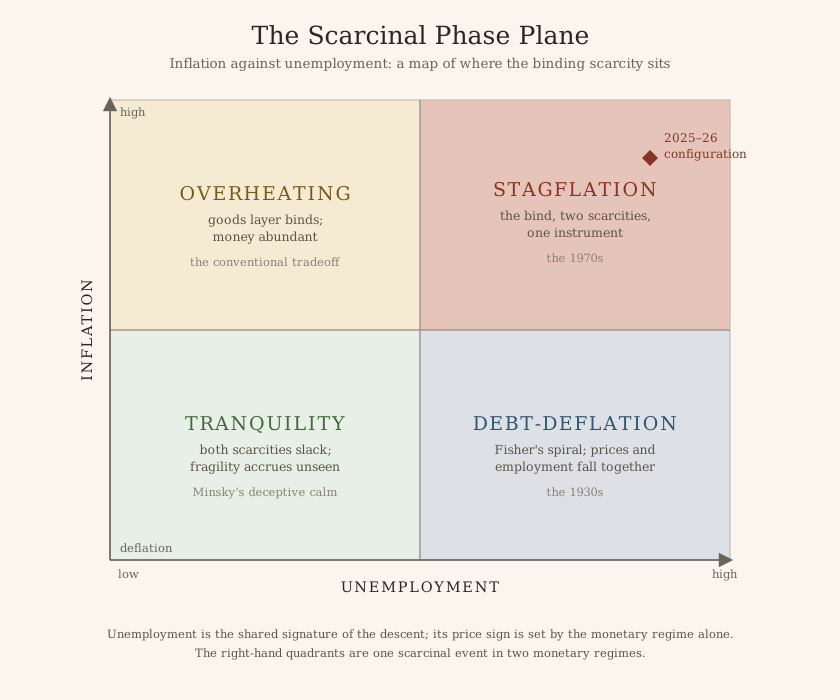
The last post drew the surface out into a simple map: inflation up the side, unemployment along the bottom, four quadrants. This post reads it, because the map settles a confusion that has dogged economics for fifty years. Two of the worst episodes of the last century, the deflationary depression of the 1930s and the stagflation of the 1970s, appear to be opposites. One had collapsing prices, the other soaring prices. Yet in this framework they are the same thing wearing different clothes.
The four quadrants
Lower-left, where inflation and unemployment are both low, is calm. But it is the deceptive calm of the second post, the years when fragility is quietly building. Upper-left, high inflation with low unemployment, is ordinary overheating: too much demand chasing goods while money is plentiful. This is the one quadrant where the old tradeoff actually describes reality, and it is the least dangerous.
The two right-hand quadrants are where the trouble lives, because both are places the master scarcity has descended and is counterfeiting a real contraction. Lower-right is deflation alongside high unemployment: the dash for cash dragging prices and jobs down together. This is Fisher's spiral, the shape of the 1930s. Upper-right is high inflation alongside high unemployment: the same descent, the same lost jobs, but with prices rising instead of falling. This is stagflation, the shape of the 1970s.
The same event, two climates
Here is the recognition that ties it together. In both right-hand quadrants the binding scarcity is money, the descent is underway, and the constant signature is the unemployment. What differs between them is only the direction of prices, and that direction is not set by the descent itself. It is set by what is happening to the value of money alongside the descent.
Where the money itself is sound and trusted, the scramble for it drives prices down, and we call the result debt-deflation. Where the money is being debased, or hammered by a supply shock like an oil embargo, the same scramble plays out against a backdrop of rising prices, and we call the result stagflation. The unemployment is the same in both. The price sign is just the weather. Deflation and stagflation are not opposites. They are one underlying collapse, photographed in two different monetary climates.
Why the tradeoff was always doomed
This is also why the tidy inflation-unemployment tradeoff was never going to hold. The two right-hand quadrants share a single cause and differ only along an axis that has nothing to do with that cause. No smooth curve can possibly connect a point of high-inflation distress to a point of low-inflation distress, because they are not two ends of a tradeoff. They are the same distress in two disguises. Looking for a stable curve to link them was looking for a relationship that does not exist.
The quadrant with no exit
One quadrant deserves special fear, and it is the upper-right. In every other corner of the map a single tool works. Against overheating you tighten; against a deflationary spiral you ease. But in stagflation the tools contradict each other. Raise rates to fight the inflation and you deepen the unemployment. Cut rates to fight the unemployment and you feed the inflation. One hand, two problems pulling opposite ways. It is the worst place a central bank can find itself, and it is exactly where the framework reads the present economy as sitting. The dispatches pick that up; this series turns next to the factor that decides whether any of these descents becomes permanent: time.