Scarcinality
An Essay on the Ordering of Scarcities in a Credit Economy
I. The Coinage
Economics defines itself as the science of scarcity: the study of how finite means are allocated among competing ends. Yet the discipline has been strangely incurious about scarcity's internal structure. It treats scarcity as a single undifferentiated condition, a flat background against which the drama of allocation unfolds. Things are scarce, we economize, and that is taken to be the end of the matter.
This essay argues that scarcity is not flat. It is ordered. Different scarcities stand in determinate relations of priority to one another. Some govern and some are governed, arranged in a hierarchy that holds firm in calm conditions and shows itself most violently in crisis. I call this ordering principle scarcinality: the cardinality of scarcities, the proposition that in any economy organized around money and credit the scarcities that bind are ranked, and that the binding scarcity, the one that actually constrains the system at a given moment, is not fixed. It moves up and down the ranking as conditions change.
The thesis can be stated compactly. In a credit economy, the scarcity of money is logically and causally prior to the scarcity of goods. Goods become scarce, when they do, largely because money has become scarce first. The orthodox picture, in which real resources are the fundamental constraint and money a veil drawn over them, has the order reversed. It mistakes the governed scarcity for the governing one.
The intellectual debt here is owed first to Hyman Minsky, then to Irving Fisher and John Maynard Keynes, and at one remove to the whole monetary tradition that insists money is not neutral. It is owed most directly of all to a living body of work that this essay should name at the outset: the Money View associated with Perry Mehrling, and its central idea of a hierarchy of money. That framework already holds that monetary systems are inherently hierarchical, that credit is payable in money but money is scarce, and that the central bank manages the system from its position at the top. Scarcinality does not discover those claims. What it does is generalize the hierarchy of money into a wider ordering of scarcities, fuse it with Fisher's debt-deflation and the Phillips surface, and carry the whole into a single organizing metaphor. Minsky never used this vocabulary, but the financial instability hypothesis, read closely, is a theory of how scarcity migrates across the levels of an economy, and that migration is what scarcinality names.
II. The Orthodox Scarcinality and Its Inversion
Begin with the picture scarcinality means to overturn.
In the classical and neoclassical imagination, real resources are the bedrock. Land, labor, and capital are genuinely finite, and from their finitude all economic constraint descends. Money, on this view, is an accounting convenience, a lubricant or veil, the unit in which the real is denominated but not the thing by which it is governed. Say's Law expresses the deepest commitment of the position. Supply creates its own demand, and production generates exactly the purchasing power needed to absorb it. So a general deficiency of demand, a situation in which money has gone scarce relative to goods across the whole economy at once, is held to be impossible. Particular gluts may occur. A general glut may not.
Under this orthodox ordering, real scarcity governs and monetary scarcity is derivative or illusory. If goods go unsold, the reason must be that they are the wrong goods, mispriced or misallocated, and not that money itself has dried up. The remedy is always to let relative prices adjust until the real pattern of supply matches the real pattern of demand once more. Money never binds. Only resources bind.
The inversion that scarcinality proposes runs the other way. In a credit economy, production is financed by debt, positions in assets are carried by borrowing, and yesterday's investment decisions are validated only so long as refinancing remains available. In such an economy money and credit are themselves a resource, and a peculiarly treacherous one, since their supply is elastic in the expansion and brutally inelastic in the contraction. When that resource goes scarce, it does not announce itself as one shortage among many. It propagates downward through every layer of the real economy, manufacturing the appearance of real scarcity where none physically exists.
The word that matters is appearance. The factories still stand. The inventories still sit on the shelves. The workers are still willing and able. Nothing in the physical productive base has been destroyed, and yet the economy behaves as though a great scarcity had descended. Output falls, exchange contracts, want spreads. The thing that has actually gone scarce is the monetary claim that mobilizes real resources into use. This is the paradox scarcinality is built to explain: generalized want amid undiminished plenty.
III. Minsky's Migration
Minsky's financial instability hypothesis is usually summarized as a theory of cycles. Stability breeds risk-taking, risk-taking breeds fragility, and fragility breeds the Minsky moment when the structure cracks. That summary is correct but incomplete. At a deeper level the hypothesis describes the gradual ascent of financial scarcity up the scarcinal ranking during the boom, and its sudden seizure of the top rank in the bust.
Recall Minsky's taxonomy of financing postures. The hedge unit can meet all its obligations, principal and interest alike, from its own cash flows. The speculative unit can cover interest but must roll over principal, depending on the continued willingness of markets to refinance. The Ponzi unit cannot even cover interest from cash flow and survives only by borrowing more or selling assets into a rising market. Across a long expansion the weight of the system shifts from hedge toward speculative toward Ponzi, because tranquility makes the riskier postures look safe and the conservative ones look like money left on the table.
Consider what that shift amounts to in the language of scarcinality. As the financing structure migrates toward speculative and Ponzi postures, the whole system becomes progressively more dependent on one thing: the continued, uninterrupted availability of refinancing. Link by link, the economy mortgages its solvency to the permanent abundance of credit. It is promoting monetary availability to the position of the binding constraint, all the while believing, because credit is abundant at present, that it has done no such thing.
The Minsky moment is the instant the bluff is called. Some shock, and it scarcely matters which, interrupts the flow of refinancing. The speculative units cannot roll their principal. The Ponzi units cannot cover their interest. Here scarcinality shows itself in its rawest form, for all of these units reach at the same moment for the same thing. They reach for cash. They must sell assets to raise it, or borrow it, and they are all trying to do both at once. The demand for liquidity becomes for a moment nearly unbounded, while the supply of it collapses toward zero, since everyone wants it and no one will part with it. Money, the thing the orthodox picture said could never be generally scarce, becomes the scarcest thing in the world.
This is the dash for cash, and it is the purest demonstration of scarcinality that economics affords. Within days an economy that was drowning in liquidity discovers that it cannot find a dollar. Nothing real has changed. Every factory, every house, every machine sits where it sat the week before. What has changed is that financial scarcity has seized the top of the ranking, and everything below it must now reorganize around that fact.
IV. The Descent: How Financial Scarcity Counterfeits Real Scarcity
If financial scarcity stayed in the financial layer it would trouble bankers and no one else. Its wider significance, and the reason scarcinality is a theory of the whole economy rather than of its plumbing, lies in the way monetary scarcity descends into the real economy and there counterfeits a scarcity of goods.
The descent runs through Fisher's debt-deflation, which Minsky absorbed and extended. The forced sellers, scrambling for cash, dump assets and inventories at whatever price they will fetch, and this drives prices down. But the debts are fixed in nominal terms, so falling prices raise the real burden of the debt: every dollar owed now represents more goods, more labor, more sacrifice than it did before. The debtor who sells to escape his obligations finds those obligations growing faster than he can shed them. In Fisher's formulation, the more the debtors pay, the more they owe. The liquidation meant to relieve the scarcity of cash instead deepens it, because it destroys the very prices and incomes from which cash was to be raised.
Watch what this does to goods. As prices fall and debts loom larger, every economic unit retrenches. Firms cut production, not because they cannot produce but because they cannot sell at prices that cover their fixed obligations. They lay off workers, not because the work has vanished but because the wage bill has become unbearable against collapsing revenue. The laid-off workers, their incomes gone, cut their own spending, which removes demand from other firms, which cut their production in turn. The spiral is the familiar Keynesian contraction, but scarcinality lets us see what it is: financial scarcity reproducing itself, level by level, as a pseudo-scarcity of goods and work.
Here the paradox sharpens to its point. At the bottom of this spiral sits an economy in which goods are physically more abundant relative to demand than ever, with warehouses full, shelves stocked, and capacity idle, and yet in which people go without. Want and surplus coexist. The Depression-era image of crops plowed under and milk poured into ditches while families went hungry is not an aberration to be explained away. It is scarcinality made flesh. The goods were not scarce. The money that would have moved them from the field to the hungry was scarce. The scarcity was real, but it lived one level up from where the suffering appeared.
This is the decisive claim. Real scarcity, in a Minsky crisis, is largely counterfeit, a monetary scarcity wearing the costume of a goods scarcity. The orthodox economist, seeing unsold goods and unemployed men, reaches for explanations in terms of real maladjustment: wrong wages, wrong prices, structural mismatch. Scarcinality says to look one level up. The binding constraint is not in the goods layer. It has been imported into the goods layer from the financial layer above it.
V. Liquidity as the Master Scarcity
Why should the monetary layer hold this privileged rank? Why is money's scarcity prior, rather than merely one among many?
The answer lies in what Keynes called liquidity preference, and in the special role money plays as the asset that links the present to an uncertain future. In a world of radical uncertainty, which is Keynes's world and Minsky's, money is not only a medium of exchange. It is a store of protection against the unknown, the one asset whose value is certain in the unit in which obligations are denominated. When confidence is high this protective function lies dormant, money circulates freely, and its latent power to halt the entire machine stays invisible. When confidence collapses the protective function comes to the front: everyone wants to hold the safe asset, no one wants to part with it, and the rush toward safety drains the system of its means of exchange.
This is why monetary scarcity governs rather than follows. Every real transaction in the economy must pass through the monetary layer, since every purchase, every wage, and every debt payment is mediated by money. The goods layer is therefore downstream of the monetary layer in a strict mechanical sense. A scarcity in money is a scarcity in the medium through which all real activity is conducted, so it transmits to everything, whereas a scarcity in any single good transmits only to its substitutes and complements. Money's scarcity is general by nature; a good's scarcity is particular by nature. That asymmetry is the foundation of the ranking. Money sits atop the hierarchy not by accident or convention but because it is the universal solvent of exchange, and a scarcity of the solvent is a scarcity of exchange itself.
It is worth pausing on the quantity by which the master scarcity is actually measured, because it clears up a common confusion. That quantity is velocity, the rate at which a unit of money turns over, passing from hand to hand, in a given period. Fisher's equation of exchange, the identity that money times velocity equals prices times transactions, makes velocity the term that converts a stock of money into a flow of spending. Velocity is the dial on which the scarcinal rank registers. When money is a humble medium, content to be passed along, velocity runs high and the economy hums. When money is promoted to the prize, hoarded rather than passed, velocity collapses, and the same stock of dollars performs a fraction of the work it did before. The effective supply of money is not the printed stock but the stock multiplied by its willingness to move, and that willingness is the first casualty of fear.
The point worth holding onto is that velocity is a symptom and not a cause, a reading rather than the disease. It is tempting to say that crises are caused by money circulating too slowly, as though the cure were simply to hurry it along. But the slowdown and the hoarding are not two events. They are one event seen from two sides. Money slows because everyone is reaching to hold it, and everyone reaches to hold it because it has climbed to the top of the scarcity order. This is Keynes's paradox of thrift rendered in the language of circulation: each person's individually prudent decision to hold cash, summed across all, starves the very flow of incomes from which cash is earned. In the Great Depression the money stock contracted by roughly a third, the figure Friedman and Schwartz made famous, while the velocity of money fell sharply alongside it, not as a separate misfortune but as the visible tracing of the master scarcity seizing the rank. One cannot exhort velocity back to health, because velocity is not a behavior to be corrected but a thermometer reading the temperature of fear. To raise it, one must relieve the scarcity it is measuring, which is the office of the institution we turn to next.
Hence the lender of last resort. The whole institution of central banking, in its crisis function, is best understood as a manager of scarcinality, an agent whose task is to prevent financial scarcity from seizing the top rank and propagating downward. Bagehot's old rule, to lend freely against good collateral at a penalty rate, is a scarcinal intervention. It floods the monetary layer with liquidity so that the scarcity there cannot descend and counterfeit a scarcity of goods below. The central bank cannot create wheat or steel or labor. What it can do is refuse to let a shortage of the universal medium masquerade as a shortage of the particular things. It works on the master scarcity so that the subordinate scarcities are never falsely triggered.
VI. The Engine and the Surface: Fisher's Chain and the Phillips Plane
The descent described in Section IV was given qualitatively, as financial scarcity propagating downward to counterfeit a scarcity of goods. To make the principle operational, two further instruments are needed: an engine that specifies the mechanical sequence of the descent, and a surface on which the descent can be observed as it happens. Irving Fisher supplies the engine in his debt-deflation theory. The relation associated with A.W. Phillips supplies the surface. Scarcinality's contribution is to show that these two famous constructs, usually held apart, are the same phenomenon seen from two sides, and that reading them together resolves the puzzle that has dogged each in isolation.
Take the engine first. Fisher's chain, set out in 1933 as the anatomy of a great depression, is a sequence of nine links, and it repays tracing in order, because the order is the argument. It begins with a state of over-indebtedness, which sets the stage. A shock prompts debt liquidation and distress selling. The distress selling contracts the deposit currency as bank loans are paid down, and the velocity of circulation slows, so the money supply in effect shrinks. That contraction produces a fall in the price level, a swelling of the dollar. Here the chain turns vicious, for the debts are fixed in nominal terms: as prices fall, the real burden of every debt rises, so that the very act of liquidation enlarges what it was meant to reduce. From this follow, in cascade, a still greater fall in the net worth of business and a wave of bankruptcies, a like fall in profits, and a reduction in output, trade and employment. Then a spreading pessimism and loss of confidence, a hoarding of cash that slows velocity further still, and finally a perverse disturbance of interest rates, in which nominal rates fall even as real rates climb. The signature is Fisher's own paradox, already met in Section IV: the more the debtors pay, the more they owe.
Read scarcinally, Fisher's chain is the descent rendered as a self-feeding loop, a mechanism in which relieving the symptom deepens the cause. Each debtor's rush for cash is individually rational and collectively catastrophic, because the cash they chase is the master-scarce resource, and chasing it destroys the prices and incomes from which cash is made. The chain is financial scarcity manufacturing its own intensification while wearing the mask of a goods-and-labor collapse. It is the formal engine of the counterfeit.
Now the surface. The Phillips relation, in its naive form, plots the inflation rate against the rate of unemployment and reports a tradeoff: lower unemployment is bought with higher inflation, and the reverse. For a generation this was read as a stable menu from which policy could choose. Then, in the stagflation of the 1970s, the menu dissolved. Inflation and unemployment rose together, which the stable tradeoff declared impossible. The expectations-augmented correction of Friedman and Phelps salvaged the apparatus by making the curve shift with inflation expectations and stand vertical in the long run at a natural rate, so that no permanent tradeoff exists at all. This was a real improvement, but it left the deeper question unasked. Why does the surface move? What is doing the shifting?
Scarcinality answers that the Phillips relation is not a closed law of the goods layer but a projection of it, a two-dimensional shadow that the goods-and-labor layer casts, and the shadow moves because the layer is open from above, deformed by whatever the monetary layer is doing. The curve was never a self-contained tradeoff to be exploited. It was a surface across which the descent of financial scarcity registers as motion. Its instability is not a defect in the relation but the financial layer asserting itself through the relation. To ask for a stable Phillips curve is to ask the shadow to hold still while the object that casts it moves.
The synthesis is a phase plane. Plot inflation on the vertical axis and unemployment on the horizontal, and the plane divides into four quadrants, each a distinct scarcinal state. In the lower-left, with low inflation and low unemployment, both scarcities are slack. This is tranquility, though it is Minsky's deceptive tranquility, the calm in which the financing structure migrates toward fragility and financial scarcity is promoted, unseen, toward the top of the rank. In the upper-left, with high inflation and low unemployment, the goods layer itself is binding under demand pressure while money remains abundant. This is ordinary overheating, the one quadrant the naive tradeoff describes well. The two right-hand quadrants are where the master scarcity has descended, and they are the heart of the matter. The lower-right, with deflation or near-deflation alongside high unemployment, is the pure Fisherian descent, the dash for cash collapsing prices and employment together, the spiral of the 1930s. The upper-right, with high inflation and high unemployment at once, is stagflation: financial scarcity descending to raise unemployment, while the money itself is simultaneously debased or supply-shocked so that prices rise rather than fall. This was the quadrant of the 1970s, and, as Section VIII will argue, the quadrant toward which the configuration of 2025–2026 leans.
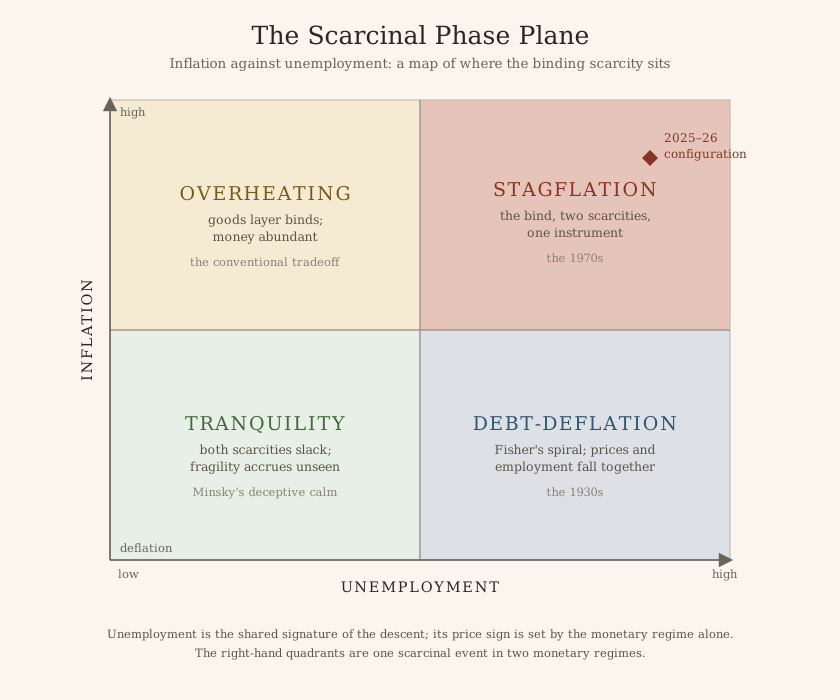
The decisive recognition is that the two right-hand quadrants are not opposites. They are the same scarcinal event in two monetary regimes. In both, financial scarcity has seized the top rank and is counterfeiting a real contraction, and in both the unemployment is the constant, the shared signature of the descent. What differs is only the sign of the price level, and that sign is set not by the descent itself but by what is happening to the value of money alongside it. Where the monetary regime is sound, the descent shows as deflation, and we call it debt-deflation. Where the regime is debased or supply-shocked, the same descent shows as inflation, and we call it stagflation. The naive Phillips tradeoff dissolves because these two states share a cause and differ only in a dimension orthogonal to that cause. No smooth curve can connect them, because they are not points on a tradeoff but two costumes worn by one underlying scarcity.
This is also why the upper-right quadrant is the scarcinality manager's nightmare, and the formal core of the bind sketched in the worked example to come. In every other quadrant a single instrument suffices: ease against the lower-right, tighten against the upper-left. But in stagflation the instruments contradict. Easing to fight the unemployment feeds the inflation. Tightening to fight the inflation feeds the Fisherian spiral that is generating the unemployment. The two scarcities pull in opposite directions along orthogonal axes, and the manager has one hand for two problems. The Phillips plane, read scarcinally, is therefore not a menu of social choices at all. It is a map of where the binding scarcity sits, and movement across it is movement of the rank.
VII. The Temporal Axis: Acute Scarcinality and Chronic Scarcity
The picture so far is of the acute crisis, and in the acute crisis the verdict is clean: the scarcity is monetary, the goods are abundant, the want is counterfeit. But scarcinality has a temporal dimension that complicates and completes the account, and honesty requires it be drawn out.
The monetary scarcity of the acute phase, if allowed to persist, does eventually become a real scarcity. The mechanism is the destruction of productive capacity. Firms forced into prolonged distress do not merely idle their capacity; given enough time, they scrap it. Machines are sold for salvage, plants are demolished, skilled workforces disperse and their skills atrophy, and the knowledge embedded in going concerns evaporates when those concerns are liquidated. Investment, the activity by which capacity is renewed and expanded, is the first thing cut in a crisis and the last thing restored, so even the maintenance of existing capacity falters. What began as a purely financial scarcity, leaving the real base untouched, slowly eats into that base.
So the full account has two phases. In the acute phase, financial scarcity seizes the top rank and projects a counterfeit scarcity downward onto goods that remain physically abundant, and here the orthodox economist who sees real scarcity is simply mistaken. In the chronic phase, if the acute scarcity is not relieved, the counterfeit becomes genuine. Capacity is destroyed, the productive base contracts, and the economy emerges from the crisis genuinely poorer in real terms, able to produce less than it could before. The scarcity has migrated back down the ranking, from money to goods, no longer as illusion but as fact.
This temporal structure is why the speed of crisis response matters so decisively, and why the scarcinal manager, whether central bank or fiscal authority, operates under such pressure. The window in which financial scarcity can be relieved before it hardens into real scarcity is finite. Intervene early, and you have merely lent some liquidity that is repaid as confidence returns, the real base intact, the counterfeit scarcity dispelled at modest cost. Intervene late, and you are no longer fighting a monetary illusion but a real diminution of capacity that no amount of liquidity can restore, because the machines are already scrapped and the skills already gone. The 1930s and 2008 differ less in their precipitating financial shocks than in the speed and scale of the scarcinal intervention, and therefore in how much counterfeit scarcity was permitted to harden into the real thing.
VIII. A Worked Example: The American Configuration of 2025–2026
A theory earns its keep on a live case, where the outcome is not yet known and the framework must do predictive rather than merely retrospective work. The configuration of the United States economy at the time of writing, in the middle of 2026, offers an unusually clean one. The governing administration has undertaken, whether by design or by instinct, something the framework regards as close to impossible: the attempt to abolish financial scarcity by political means. Tracing how that attempt interacts with the scarcinal ranking is the best available illustration of the principles laid out above.
Consider the levers being pulled at once. On the fiscal side, a sweeping tax law passed in 2025 delivered cuts on the order of four and a half trillion dollars, offset in part by reductions to health, nutrition, and education transfers. The result was that the lowest-earning households, those below roughly fifty thousand dollars of annual income, were projected to see their after-tax incomes fall even as the aggregate package expanded. Large tax refunds were channeled into household hands as a near-term spending impulse. Take the trade side first. The administration's tariff regime was built on emergency executive authority, and in early 2026 the Supreme Court struck it down as an unconstitutional usurpation of a power reserved to the legislature. The administration pivoted at once, assembling a roughly fifteen-percent global import surcharge out of other statutes. Then the monetary side. A sustained campaign of pressure against the central bank included an attempt to remove a sitting governor and a criminal investigation of the outgoing chair. A new and more compliant chair was installed, with an explicit mandate to lower interest rates sharply. Over all of it lay a foreign conflict that drove an energy-price shock, nudging headline inflation upward against a price level already running above the central bank's target.
Read flat, this is simply an aggressive pro-growth program. Read scarcinally, it is an attempt to push every scarcity downward at once. To suppress monetary scarcity at the short end through a captured rate-setter, to flood the goods layer with refund-financed demand, and to do both while the productive base is squeezed from above by tariffs and an energy shock. The framework's first prediction is that the master scarcity cannot be abolished this way, only relocated. Suppress it at the short end and it reappears at the long end of the curve, in the term premium, and in the currency. That is precisely what the evidence showed. The judicial nullification of the tariffs, far from relieving pressure, widened it, because the resulting refund obligations enlarged an already vast deficit, and long-dated sovereign yields rose on exactly that fiscal fear. The bond vigilantes are nothing other than financial scarcity refusing to be banished, presenting its bill at the one point on the curve the administration cannot directly command.
The framework's second and graver concern is structural: the deliberate degradation of the scarcinality manager in advance of the crisis it exists to fight. The lender of last resort can suppress an acute dash for cash only on the strength of its credibility, the market's belief that emergency liquidity is a temporary loan against panic rather than a permanent debasement. That credibility is a reserve, accumulated over decades of demonstrated independence, and it is spent down each time the institution is bent to the fiscal will of the executive. An administration that installs a compliant chair to force rates lower is, in scarcinal terms, drawing down the very reserve that the next emergency will require. The tell is that the market did not believe the easy-money boom: even with a hand-picked chair in place, expectations settled on rates held flat through the year and possibly rising thereafter. The chair changed. The bond market's skepticism did not. The manager's words had been pre-discounted.
From these two observations the framework casts a specific future condition, not a prophecy but a conditional, the shape the risk takes. The configuration is a stagflationary bind, the upper-right quadrant of the phase plane of Section VI, and it is the single worst arrangement a scarcinality manager can face, because in it the two scarcities pull in opposite directions and no single instrument can address both. The tariff surcharge and the energy shock press goods-side costs upward, a real-scarcity pressure. The deficit and the debasement fear press the financial-scarcity premium upward at the long end. Should a Minsky-type trigger then arrive, whether a credit event, a failed sovereign debt auction, or a deepening of the energy shock, the compromised manager confronts a trap with no clean exit. To flood liquidity and relieve the dash for cash would terrify an already nervous bond market and currency, reigniting the inflation the goods side is generating. To withhold liquidity and defend the currency would let financial scarcity complete its descent and counterfeit a real contraction. The acute-phase rescue, in other words, has been blunted before the acute phase arrives, which is exactly the condition under which the framework predicts that the counterfeit scarcity of the acute phase hardens into the genuine scarcity of the chronic phase. The capacity-destruction mechanism of Section VII becomes more probable, not because the financial shock is larger but because the instrument that would have arrested it has been politically pre-spent.
Where would this show first? The framework is specific, following the gradient of the next section: in the credit-coupled goods. Housing and automobiles, the durable, debt-financed purchases whose demand is a demand for credit, are the diagnostic layer, the canaries. A softening in those markets, a glut of unsold inventory beside an undiminished population of would-be buyers, would be the early signature of financial scarcity beginning its descent, visible long before it reaches the weekly cash purchases at the insulated bottom of the ranking.
Honesty requires the other branch of the fork be drawn with equal care, because the framework describes a distribution of outcomes and not a single fated one. The administration's bullish case is internally coherent. Refunds plus lower rates plus deregulation could fire a genuine demand-led expansion, and if the energy shock fades and inflation stays contained, the suppression of short-end financial scarcity may simply succeed, with no Minsky moment ever arriving to test the weakened manager. The honest scarcinal verdict is therefore not a forecast of doom but the characterization of a bet. The administration is stacking stimulus upon stimulus while drawing down the credibility of the one institution built to contain a financial-scarcity spiral. That combination does not determine the outcome. It widens the variance of outcomes in both directions, a fatter right tail of authentic boom and a fatter left tail of a stagflationary trap with the safety net pre-cut. Which tail is realized depends on shocks no theory can schedule. What the framework contributes is not the prediction of which tail, but the recognition that the policy mix has thickened both, and that the left tail is heavier because the scarcinality manager was disarmed before the fight.
IX. The Goods That Reveal the Ranking
Not all goods sit at the same depth in the scarcinal hierarchy, and the gradient among them is itself instructive. The goods most tightly coupled to the financial layer are those whose acquisition is normally financed by credit: housing, automobiles, capital equipment, the durable big-ticket items that few buy from current income. Their demand collapses first and hardest when financial scarcity strikes, because their demand is a demand for credit as much as for the good. When refinancing seizes up, the would-be homebuyer and the would-be car-buyer simply vanish from the market. They do not stop wanting the house or the car, and the house and the car have not grown physically scarce; the credit that would have conveyed the good to them has evaporated.
These credit-coupled goods are therefore the diagnostic goods of scarcinality, the place where the descent of financial scarcity becomes visible earliest and clearest. A glut of unsold houses beside a population that wants housing, a lot full of unsold cars beside commuters who need them: these are the signatures of a scarcity that lives in the financial layer and only appears in the goods layer. The further a good sits from credit, the more it is bought from current income, and the cheaper and more frequent its purchase, the more insulated it is, and the later financial scarcity reaches it. Necessities bought weekly with cash are the last to feel the descent; capital goods bought once a decade with debt are the first. The gradient of credit-dependence is the gradient of scarcinal depth.
X. The Two Flights: Crypto and the Direction of Escape
A framework earns further credibility if it can be turned on an instrument that did not exist when it was built. Cryptocurrency is such an instrument, and it is usually discussed in exactly the wrong terms, as though the only question were whether it is a safe haven or a risk asset, a fixed property to be settled once and for all. Scarcinality dissolves the question by refusing its premise. Crypto has no fixed role in a crisis. It has two opposite roles, and which one it plays is decided by the same thing that decides everything in this framework, namely which scarcity is biting. The two right-hand quadrants of the phase plane, debt-deflation and stagflation, pull crypto in opposite directions, because the deciding variable is not the asset's nature but the direction of the flight, and the direction of the flight is set by what, precisely, people are fleeing.
Consider first the acute dash for cash, the debt-deflation quadrant, the pure Fisherian descent. Here the master-scarce asset is the dollar, for the unanswerable reason that debts are denominated in dollars. A margin call, a maturing bond, a mortgage payment: each is an obligation to deliver dollars, and no quantity of a token will discharge it. So the unit scrambling for liquidity does not flee into crypto. It sells crypto to raise the dollars it actually owes. And because crypto sits at the very summit of Minsky's fragility stack, the most speculative and most leveraged position in the system, it is not the last asset liquidated but the first. The empirical record, brief as it is, has so far obliged. In the liquidity panic of March 2020, and again in the deleveraging cascade of 2022, crypto did not behave as the digital gold its defenders had promised. It fell harder than equities, just when the haven property was being tested. This is what the framework predicts. In a true dash for cash, an asset's distance from the dollar is its vulnerability rather than its refuge, and crypto stands about as far from the dollar as an asset can.
Now reverse the scarcity. In the stagflation quadrant, or more precisely in any regime where the thing in doubt is the value of money itself, what has gone scarce is not the dollar but trust in the dollar. A central bank visibly bent to the fiscal will of the state, a deficit financed by the printing press, a unit of account losing its credibility: here the flight runs not toward the dollar but away from it, and crypto, like gold, can be its beneficiary. The episode of March 2023 is the clean illustration. As regional banks buckled, Bitcoin rose even as the banking system shook, because what depositors were fleeing in that moment was not risk in general but the soundness of the banking-and-fiat system in particular, and an asset outside that system caught the outflow. The digital-gold thesis, false in the liquidity panic, finds its hour exactly when the dollar is the thing in question. The same asset, the same week-to-week chart, means opposite things depending on which scarcity sits at the top of the rank.
Stablecoins sharpen the lesson rather than soften it. A stablecoin presents itself as an escape from the choice, the upside of crypto with the steadiness of the dollar, but scarcinally it is no escape at all, because it is not money. It is a claim on money, a promise to deliver a dollar on demand, which makes it a leveraged bet that dollars will remain available, a derivative of the master-scarce asset that inherits and amplifies the very scarcity it claims to abstract away. In the dash for cash, when dollars are scarcest, the claim is tested hardest. TerraUSD collapsed outright in 2022, and even the most reputable dollar-backed token briefly broke its peg during the 2023 bank scare. A stablecoin does not relieve dollar scarcity; it intensifies it, by manufacturing a new layer of dollar promises that must all be honored at the moment dollars are hardest to find. It is the speculative-to-Ponzi migration of Section III, rebuilt in miniature inside the monetary layer itself.
The two flights can also run in sequence, and this is what makes the instrument treacherous rather than merely two-faced. A crisis often opens in the debt-deflation quadrant. There is a liquidation, and crypto craters alongside everything else in the scramble for cash. Only then, if the rescue is read as debasement, does it rotate into the stagflation quadrant. There the same crypto rebounds furiously, on the flight from the now-suspect currency. This is, in compressed form, the arc of 2020: the March collapse, then a violent rally as the stimulus-and-debasement narrative took hold. Set against the worked example of Section VIII, the moral is sharp. A crypto-friendly deregulatory regime layered atop debasement fears does not make crypto a reliable refuge. It merely guarantees that the order of the shock will decide crypto's role. If the next seizure arrives as a liquidity panic, crypto is among the first casualties; if it arrives, or resolves, as a loss of faith in the dollar, crypto is among the things people run to. Crypto does not stand outside the order of scarcities. It is a high-beta instrument within it, an amplifier that does not escape the ranking but exaggerates whichever way the rank is moving. Its behavior in past stress is a guide and not a guarantee, the more so as its market matures into something structurally unlike its younger self. But the framework's claim is not about magnitudes. It is about direction, and direction, here as everywhere, follows the scarcity that binds.
XI. Objections and Replies
A framework is worth only as much as it can survive being argued with. Three schools would press hardest against scarcinality, and each deserves its strongest form before any answer. What follows states each objection as its proponent would make it, then replies. Two of the three replies concede real ground, which is the point: the framework is meant to be corrected where it overreaches.
The supply-side economist. The objection begins at the first move and never relents. Section II makes its name by overturning Say's Law and crowning money the binding constraint, and to a supply-sider that is not a fresh start but the founding error of the demand-side tradition in new dress. Say's Law, properly read, never denied that gluts happen. It held that a general glut is always a monetary or structural disturbance in disguise, never a true deficiency of demand for output as such. The deeper charge is that scarcinality assumes its own conclusion. Throughout, the goods layer is treated as inert capacity that switches off and on with the supply of money, never as a decision. But production is a decision, governed by the after-tax, after-regulation reward to working, saving, and investing. The binding constraint, in this view, is usually not liquidity but the willingness to produce, and no flood of central-bank money relieves it. By naming money the master scarcity, scarcinality has quietly demoted the one scarcity the supply-sider holds primary, the scarcity of the incentive to supply. Stagflation, the treatise's proudest case, is to him its clearest refutation: the upper-right bind exists only because the framework hands the monetary authority a single instrument. Give the economy two, sound money aimed at the dollar and tax and regulatory policy aimed at output, as Mundell prescribed and as the Volcker and Reagan mix delivered, and the contradiction dissolves. And the worked example, he would add, mislabels its own evidence, filing tax cuts and deregulation under stimulus when they are supply-enhancing and so anti-inflationary, more goods to chase the money rather than more money chasing the goods.
The reply. The strongest of these charges lands, and scarcinality should say so plainly. The two-instruments point is correct. The economy is not confined to one lever, and a monetary authority trapped in the upper-right can indeed be relieved by a fiscal and regulatory authority working the supply side. But this refutes a claim the treatise never made. The bind of Section VI is the bind faced by the monetary manager using monetary tools alone. To bring tax and supply policy to bear is, in the framework's own language, to attack a different scarcity, the real constraint in the goods layer, with a different instrument, which is entirely consistent with a theory whose first principle is that the binding scarcity moves. The supply-sider and scarcinality are not opponents here. They are describing two scarcities and assigning each its tool. The genuine disagreement is narrower, and it concerns the acute phase. In a true dash for cash the incentive to produce is not the binding constraint. A solvent manufacturer with full order books and every reason to run his plant still cannot make payroll if the credit line he rolls over every ninety days vanishes overnight, and no marginal tax rate thaws a frozen interbank market in the days that decide the matter. That is the case scarcinality is built on, and there money is genuinely master. The honest amendment is the one Section VII already gestures toward. In the credit economy's panics, and in its daily plumbing, money holds the top of the rank. But in tranquil times, and across the long chronic phase, the binding scarcity can be the incentive to supply. There the supply-sider is right. As for the irony he presses hardest, that a framework which fears debasement prescribes flooding the system with money, it rests on a conflation. Bagehot's rule is to lend freely against good collateral at a penalty rate, and such lending is repaid as the panic passes and need debase nothing. That is a different act from financing deficits with the printing press, which is what the worked example actually fears in its captured central bank. Lending against collateral relieves the master scarcity. Monetary finance of spending debases the unit. Scarcinality fears the second and prescribes the first.
The traditional Keynesian. This critic is the nearest ally and therefore the most exacting. His complaint is that scarcinality over-monetizes Keynes. The heart of the General Theory was effective demand, and the collapse of demand traces to the marginal efficiency of capital and to the animal spirits behind investment, not merely to a shortage of money. The proof is the liquidity trap, the case Keynes cared about most, in which money is already ample and demand still fails, because investment will not respond at any interest rate the central bank can reach. Pushing on money there does nothing. You cannot push on a string. So to crown money the master scarcity is to misread the master himself. The binding scarcity in a trap is not money but the desire to invest and to spend, and the remedy is therefore not a clever liquidity manager but a fiscal authority spending directly to fill the gap. The treatise leans on the lender of last resort and underweights the Treasury, and in doing so, the Keynesian charges, it relabels a deficiency of demand as a monetary phenomenon and thereby buries the very lesson, fiscal expansion, that the relabeling should have produced.
The reply. Here scarcinality must be careful, because the objection is part right and part a misreading of what master scarcity means. The master scarcity is not the quantity of base money. It is liquidity in the deeper sense the treatise took from Keynes himself: the willingness to part with money set against the desire to hold it, which is liquidity preference. Read so, the liquidity trap is not a counterexample to the framework but its most extreme instance. In a trap what has gone scarce is precisely the willingness to let money go. Everyone holds it, including every fresh dollar the central bank prints, which is exactly why pushing base money accomplishes nothing. Money has climbed so far up the rank that it has pinned the whole system, and velocity has fallen to the floor. Scarcinality and Keynes are saying one thing in two vocabularies. The fiscal remedy then follows with the grain rather than against it. Government spending works, in this language, because it forces money to move when no one will move it voluntarily. It breaks the hoard and lifts velocity directly, instead of waiting on a rate cut that cannot reach. The treatise already allows this when it names the scarcinality manager as the central bank or the fiscal authority, and the Keynesian is right to insist the second is decisive in a trap. The fair concession is one of emphasis. The treatise spends more of its attention on the lender of last resort than on the spending authority, and a reader could close it believing the rescue is always monetary. It is not. The manager is whoever can break the hoard, and in the trap that is the Treasury.
The monetarist. He grants that money is supreme and parts company on everything after. Money matters, he says, through its quantity, not through the moods of liquidity preference. The Depression was no mysterious descent and no failure of animal spirits. It was the Federal Reserve permitting the stock of money to fall by about a third, a quantity failure with a quantity cause. Scarcinality's fascination with velocity, hoarding, and the dash for cash overstates a variable that is, over any reasonable horizon, fairly stable and predictable, and treats shifts in the demand for money as primary when they are second-order to control of its supply. Worse, the framework enthrones the very agent the monetarist blames for the century's monetary disasters, a discretionary lender of last resort. Discretion is the disease. The remedy is a rule, a steady and pre-announced rate of money growth that lifts the manager's hand from the dial, because it was that hand, in 1930 and again in the 1970s, that turned ordinary disturbances into catastrophes. Control the quantity steadily and the dramatic panics the treatise treats as the nature of things would largely cease, being for the most part the artifacts of central banks mismanaging the supply.
The reply. The common ground is wide and worth naming: money is master, and the captured, debasing central bank of the worked example is as much a monetarist's nightmare as anyone's. The disagreement is over which part of money binds. The monetarist's stable velocity is a fact of tranquil times and a casualty of exactly the episodes this essay is about. Friedman and Schwartz themselves recorded velocity falling alongside the money stock in the Depression, and 2008 and 2020 showed it collapsing within days. Scarcinality's claim is the narrow one a pure quantity view cannot easily hold: the effective supply of money is the stock multiplied by its willingness to move, and it is the second term that seizes in a panic. A fixed money-growth rule, admirable in calm weather, would have been ruinous in late 2008, when holding base-money growth constant while velocity fell off a cliff would have been a savage monetary tightening in all but name. That is also the answer on discretion. Scarcinality shares the fear of an unconstrained manager, and the worked example is a sustained warning about one. But the cure for bad discretion is not the absence of discretion, which a velocity collapse silently converts into tightening by inaction. It is constrained discretion of the Bagehot kind, lending freely against good collateral at a penalty rate and unwinding as the panic passes, which is rule-like in its discipline without being blind to the one variable a quantity rule must ignore. On a last point the monetarist and the treatise simply agree, and the text already says so. The phase plane is a description of where the economy sits, not a menu the authorities can order from. There is no exploitable tradeoff to be won by steering toward a quadrant.
A closing note on the three. It is worth seeing what the objections share. Each, in its own way, relocates the binding scarcity: the supply-sider to the incentive to produce, the Keynesian to the desire to invest, the monetarist to the quantity of money. That they disagree among themselves about where it sits is the best evidence for the one claim this essay most wants to defend, which is not that money is always the answer but that the binding scarcity is real, singular at any given moment, and movable. Scarcinality's wager is only that in the credit economy's crises the movable rank settles, more often than not, on money. Where it settles elsewhere, the framework asks to be corrected, and these three are the ones equipped to correct it.
XII. Coda: The Discipline's Blind Spot
Why did economics, the science of scarcity, take so long to see that scarcity is ordered?
Because the founding move of the discipline, the move that made it a science, was to treat money as a veil and the real as the substrate. That move was enormously productive for analyzing an economy in tranquil times, when the monetary layer is transparent and the real constraints do bind. But it built into the discipline a blindness to the one circumstance in which the ranking inverts, the crisis, when the veil becomes the substance and money ceases to be transparent and becomes the most opaque and binding thing in the system. The economists who saw this were each treated in their day as heterodox. Fisher in his debt-deflation, Keynes in his liquidity preference, Minsky in his fragility. Each insisted that the ranking the discipline had frozen was in fact mobile. And each insisted that its mobility was the whole story of crisis.
Scarcinality is an attempt to name what they saw and to state it as a general principle rather than a special case. Scarcity is ordered. The binding scarcity moves. In a credit economy money sits atop the order, and when it seizes the top rank it counterfeits, downward, a scarcity of everything, until, if the counterfeit is left standing too long, it ceases to be counterfeit and becomes the real poverty it had only pretended to be. To manage an economy is, in no small part, to manage its scarcinality, to keep the scarcity of the medium from descending into a scarcity of the things the medium was only ever meant to move.
The factories stand. The shelves are full. Whether the people go without depends not on the goods but on the rank that money holds, this week, in the order of scarcities.
Sources and Provenance
This essay coins its central term but borrows its materials. What follows names the principal works behind each movement of the argument, so that the reader may trace the synthesis to its sources and judge for himself where recombination becomes invention. The framework is offered as original; the components are emphatically not, and it would be a poor theory of borrowed scarcity that was miserly about its own debts.
The inversion of the orthodox picture and the general-glut tradition (Sections II to IV) descend from the long quarrel over Say's Law: Thomas Malthus against David Ricardo on the possibility of general gluts (Principles of Political Economy, 1820), Karl Marx on crises of overproduction (Capital), and the underconsumptionists John Hobson and A.F. Mummery (The Physiology of Industry, 1889). The engine of the descent is Irving Fisher's, taken from "The Debt-Deflation Theory of Great Depressions" (Econometrica, 1933), the source of the nine-link chain and of the paradox that the more the debtors pay, the more they owe. The equation of exchange behind the treatment of velocity is from his The Purchasing Power of Money (1911).
The master-scarcity argument and its measurement (Sections V and VI) rest on John Maynard Keynes's General Theory of Employment, Interest and Money (1936) for liquidity preference, the marginal propensity to consume, and the paradox of thrift. The account of the monetary contraction of 1929 to 1933, including the finding that the money stock fell by roughly a third, follows Milton Friedman and Anna Schwartz, A Monetary History of the United States, 1867–1960 (1963). The lender-of-last-resort principle is Walter Bagehot's, from Lombard Street (1873). The Phillips surface is A.W. Phillips's original wage-inflation relation (1958), and its expectations-augmented correction, the natural rate and the vertical long-run curve, belongs to Milton Friedman's 1968 presidential address to the American Economic Association and, independently, to Edmund Phelps.
The treatment of fragility, the financing cycle, and the temporal axis (Sections III and VII) is Hyman Minsky's: the financial instability hypothesis and the hedge, speculative, and Ponzi taxonomy, developed across John Maynard Keynes (1975) and Stabilizing an Unstable Economy (1986). The consumption-function refinements that populate the broader lineage, namely Friedman's permanent-income hypothesis (1957), Franco Modigliani's life-cycle hypothesis, and James Duesenberry's relative-income ratchet, belong to the same mid-century effort to give Keynes's aggregates a microfoundation.
The single closest relative of this essay, and the one it is most indebted to, is the Money View developed by Perry Mehrling and set out across The New Lombard Street (2011) and the essays of the following decade. Honesty requires it be named plainly rather than buried among the older sources. The hierarchy of money, the formulation that credit is payable in money but money is scarce, the survival or settlement constraint that Minsky first described, and the central bank managing instability from the top of the hierarchy as lender and dealer of last resort, are all that framework's, not this one's. The Money View has also already been turned on stablecoins and on decentralized finance, the SVB and USDC episode included, so the application in Section X follows a path others opened rather than breaking new ground. A reader who knows that literature will recognize most of the load-bearing claims here. What this essay adds is not new economics but a wider frame and a different voice: the generalization from a hierarchy of money to an ordering of scarcities, the fusion with debt-deflation and the Phillips plane into a single picture, the coined vocabulary, and the essayistic treatment.
The two contemporary applications stand on a different evidentiary footing, and the distinction is deliberate. The worked example of 2025 and 2026 (Section VIII) draws on public reporting of then-current United States fiscal, trade, and monetary developments, and is offered as interpretation, a conditional reading through the framework, rather than as documentary fact. The crypto episodes (Section X) are matters of record. Three in particular. The liquidity crash of March 2020, in which Bitcoin fell more steeply than equities. The deleveraging cascade of 2022, and with it the outright collapse of TerraUSD. And the regional-bank crisis of March 2023. That week, Bitcoin rose roughly a third as Silicon Valley Bank failed, while the dollar-backed token USDC briefly broke its peg after its issuer disclosed reserves stranded at the failed bank. The pattern these episodes are made to illustrate rests on a short record, and the essay claims of it only a direction, not a magnitude.
That is the honest measure of what follows. The economics is largely borrowed, much of it from the one living framework named above. The originality, such as it is, lies in the framing, the synthesis, and the name: scarcity treated as ranked rather than flat, the hierarchy of money widened into an ordering of scarcities, the phase plane that reads debt-deflation and stagflation as one event in two monetary regimes. This is offered as a re-description meant to make a real and somewhat technical idea vivid and usable, not as a discovery, and it should be read and judged in that spirit.
Scarcinality, n. the cardinality, or ordering, of scarcities. The principle that the scarcities binding an economy are ranked rather than flat. In a credit economy monetary scarcity holds causal priority over real scarcity, propagating downward to counterfeit a scarcity of goods amid physical plenty.