Where the theory meets the tape. The framework makes conditional predictions; this is where they are written down, dated, and checked against what actually happens.
A theory that only explains the past is hard to be wrong about. Scarcinality tries to do more than that: it says, given a particular configuration, which way the binding scarcity should move and where it should show up first. The dispatches hold it to that. Three formats run here.
The standing ledger
One living document, updated rather than replaced, listing the framework's falsifiable claims and tracking each against reality. It is meant to let the theory be wrong out loud.
If the framework is right, then…
Watch
Status
A descent in financial scarcity shows up first in credit-coupled goods, before it reaches anything bought with cash.
Each claim is a hypothesis, not a forecast. The point of dating them is to make it impossible to quietly revise the theory after the fact. As of the June 2026 reading, four are marked tracking on early, consistent evidence; none is yet scored as confirmed or failed. The crypto claim was scored against six episodes in August 2026, four of which fit and one of which does not.
Where are we on the plane?
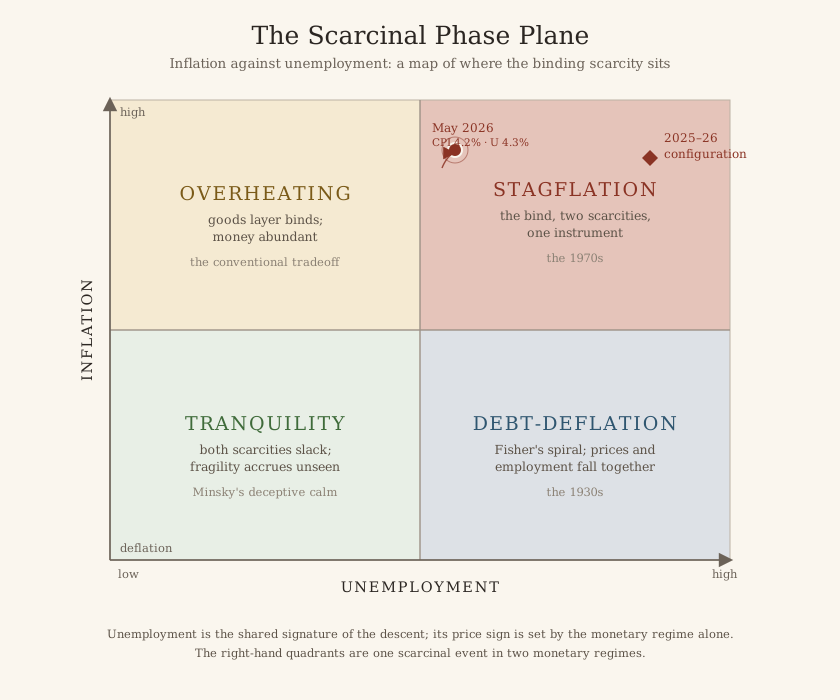
A recurring reading, plotting current inflation and unemployment onto the four quadrants and arguing which way the rank is moving. The same diagram every time, so the change from one reading to the next is the story.
TranquilityOverheatingDebt-deflationStagflation
Latest reading, June 2026: the upper-right, stagflation quadrant.
CPI 4.2 percent, unemployment 4.3 percent. The first reading lands the economy in the one quadrant where the policy instruments contradict, with the long end of the bond market confirming the bind.
Where this goes by January 2029. The likely path is a long dull grind rather than a crash. One variable decides which way it breaks, and it is not a number. It is whether the Federal Reserve chair holds the line.
Published · 15 June 2026
Themed dispatches
Standalone pieces drawn from the treatise's live material, written as conditions warrant:
American healthcare is the framework's clearest worked example. The country is told it cannot afford to cover everyone. The theory's reply is that nothing real has run out.
A roadmap to universal care, sequenced so that money stays the binding scarcity and the remedy never spills into a real one. The companion to the counterfeit-shortage reading.
The framework almost always finds the binding shortage to be monetary. The Strait of Hormuz closure is the exception, and the inversion is the whole currency trade.
An interactive model of the healthcare financing arithmetic. Adjust the employer contribution rate, administrative savings, and out-of-pocket cap; watch the national financing and household impact tables recalculate in real time.
The framework asks which shortage is real. This dispatch turns the question into a number: the Credit Counterfeit Index, updated quarterly, with a threshold, a history, and a standing call.
Ground beef at $6.80 a pound is not one thing. It is at least five stacked: drought-driven herd shortage, COVID-style meatpacking bottleneck, immigration enforcement reducing processing labor, import tariffs, and four-packer structural concentration. Separating them is what the framework is for.
A cross-commodity analysis of beef, oil, natural gas, soybeans, corn, and cotton from 2008 to 2026. The families who captured the most from tariffs, immigration enforcement, and agricultural policy own the nodes the supply must pass through, not the fields or the wells.
The CDC, NIH, and university research cuts are framed as fiscal discipline. The treatise's Section VII says to ask what comes next: monetary scarcity, if left standing, destroys the productive capacity it was only pretending to threaten. Factories can be rebuilt with money. A disease surveillance network that has dispersed cannot.
Federal research funding has fallen from 1.86 percent of GDP in 1964 to 0.63 percent today, while patents and total R&D sit at record highs. Both are true. The reconciliation is a composition shift away from the one kind of research the market cannot buy, and it explains what the current cuts are actually destroying.
Across rich countries, education spending explains almost nothing about outcomes. Within countries, causal studies find it clearly improves them. Both are true. The United States spends above average and pays teachers worse relative to other graduates than any country in the OECD, which is what a composition problem looks like when you make it concrete.
Crypto has no fixed role in a crisis. It has two opposite ones, decided by which scarcity is biting: sold in a dash for cash, bought in a flight from the currency. Four episodes fit the claim. 2025 does not, and the reason may be that the state licensed a competing exit denominated in the very currency being fled.
The treatise said money’s scarcity cannot be legislated away, only relocated, and named where it would surface. Fourteen months on the ten-year auctioned at the highest yield since the financial crisis and subprime auto delinquency hit a thirty-two year record. Three predictions held. The framework’s own gauge missed all of it, and that defect is the finding.
A wealthy household does not use more toilet paper. A household near the poverty line goes without. Necessities carry a physical ceiling income cannot raise, so moving a dollar upward destroys demand for ordinary goods that the recipient structurally cannot replace. An extension to the framework, and the third place in two months where an aggregate instrument proved unable to see the bottom of a distribution.
The supply-side mirror of the Toilet Paper Theory. Every input in the framework answers a higher price by supplying more of itself. Labor cannot, because the seller of the hour and the hour are the same object. Average weekly hours stood at 34.3 in 2006 and 34.3 in 2026 while the labor share fell to its lowest reading since the series began, which is what it looks like when a monetary descent lands on the one participant that cannot move.
A $1.80 trillion deficit in ten months, and the largest peacetime defense budget in American history. Shell production still sits at 36,000 a month against a target of 100,000. Every dollar was found. The shells did not arrive. That is this framework’s own test for a shortage that is real rather than fake, and the price then escapes into concrete, construction and everything else that needs the same ingredients.
Customs duties ran $154.5 billion in ten months against $62.7 billion two years earlier, and the effective rate is the highest since the early 1940s. The first counterfeit scarcity this framework has examined that was built on purpose: the goods exist, the ships sail, and a wedge at the border makes them unaffordable. The trap is that the policy destroys the low-end demand that would justify the capacity it is trying to summon, on a legal authority that runs 150 days.
The gauge reads minus 1.08 and its line is 4.32 summed standard deviations away. No single input can cover that distance, and the two prior breaches share almost no profile: 2008 was the price of credit with policy easing, 2023 was the quantity of money with spreads asleep. Also the conclusion the framework did not go looking for, that the energy constraint has to clear before a monetary counterfeit can be seen at all.
Spending on data centers rose 62 percent to $630 billion while the price of what they produce fell about 95 percent, to eleven cents. Money is not what has run out. Transformers take 144 weeks, grid connections up to ten years, and Microsoft says electricians are its biggest bottleneck. Unlit fiber could sit in the ground for a decade costing nothing. Idle computing rots, which is why the thing that survives a correction is the grid connection rather than the machines.
A doctor in private practice deducts nothing for an unpaid bill, because there was never any income to deduct. Most hospital write-offs are a discount rather than a deduction. The real tax expenditure is the nonprofit exemption. But the bigger number appears on no tax form at all: the study famous for shrinking medical bankruptcy to 4 percent also found earnings down 20 percent after a hospital stay. Emergency care arrives whether or not you can pay, so the shortfall becomes a debt, and then a permanent hole in the tax base.
The theory’s most falsifiable claim, tested. In the first half of 2026 national brand grocery dollars rose 2.2 percent while units fell 0.5 percent, and store brands took a record 23.8 percent of units. The manufacturers’ own filings appear to say the opposite, and resolving that is the finding: Kimberly-Clark bought 4.1 points of volume with 1.5 points of price, which is a ceiling seen from the other side. Plus the channel the theory missed, where a mega roll lost a quarter of its paper and none of its price.
Four promises of a check in nineteen months, none delivered. The funding line is running backwards in Treasury’s own books: $49.2 billion refunded in June against $23.6 billion collected. But the arithmetic is the smaller problem. A check is a monetary instrument, and the gauge reads −1.08 with the monetary bind at nothing, which means the binding scarcity is real. Right medicine, wrong disease. The bribery objection is also the weaker one.
The Toilet Paper Theory says a squeezed household buys less, and quietly assumes the thing can be bought in smaller pieces. Nobody buys two thirds of a dwelling. Divisibility turns out to be what decides whether a necessity gives way in volume or in price, which is why cheap staples and unaffordable rent are one mechanism seen twice. Meanwhile 3.56 million rental units stand empty against 745,652 homeless people, and 22.7 million renter households pay more than 30 percent of income.
The first policy-facing dispatch, and a departure. Sorting the evidence by how settled it is puts the argument in the wrong place: the aggregate has been positive throughout the period the politics got worse. The design flaw is that the government bearing the cost is not the government collecting the revenue. Six measures follow, five of which change no admission number, and the comparison against the Dignity Act and the enacted Secure America Act finds the largest of them missing from both.
Published · 6 September 2026 · Applied reading
Live conditions
The Frozen Market. Housing as the cleanest counterfeit currently on the board. Roughly 80 percent of outstanding mortgages sit below the market rate, existing sales run near 4.09 million against a population that wants houses, and the houses physically exist. Nothing has run out. A lock-in is a monetary artefact wearing the costume of a supply shortage.
Instruments and method
The Instruments Measure the Top. Three findings in two months converged on one defect: the Credit Counterfeit Index reads loose while subprime posts a thirty-two year record, no aggregate explains the divergence between corporate profits and small-firm conditions, and the federal survey of whether Americans go without is being discontinued. A proposal for a distributional gauge, and an argument that an economics built on averages reports health for as long as the people holding most of the dollars are healthy.
Stablecoins Do Not Escape the Dollar. Why a claim on dollars amplifies the very scarcity it claims to abstract away. Now a larger bet than when the treatise made it, at more than $321 billion and with a federal charter behind it.
The Captured Manager. Narrowed by what has already been scored. That degrading the lender of last resort is priced in advance is no longer the open question; it was observed. What remains is the harder one: what a pre-discounted central bank can actually do when a trigger arrives, and whether credibility spent in calm can be reassembled in a panic.
Retired from this list because it was delivered: The Attempt to Abolish Financial Scarcity, Crypto’s Two Flights and The Volume Tell. The Bond Market Sends the Bill is also retired, absorbed into the Abolish dispatch, which scored the long-end relocation claim directly rather than treating it separately.
Every dispatch rests on live figures and carries an "as of" date. They are readings through a framework, offered with the treatise's own humility: conditional, falsifiable, and about direction rather than magnitude.