The Treatise
The full argument, in eleven parts, from the coinage through the phase plane to a worked example of present conditions. Read it on the web or download the typeset edition.
Read ›Featured dispatch
Which Immigration
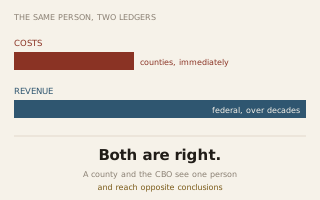
Costs land on counties now. Revenue lands federally over decades. The mismatch, not the number, drives the politics.
Featured curiosity
Aid, Migration, and the Money That Goes Home
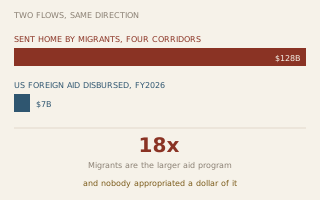
Migrants send home eighteen times what US foreign aid disbursed this year. Nobody appropriated a dollar of it.
An economic theory
A shortage of money looks like a shortage of everything.
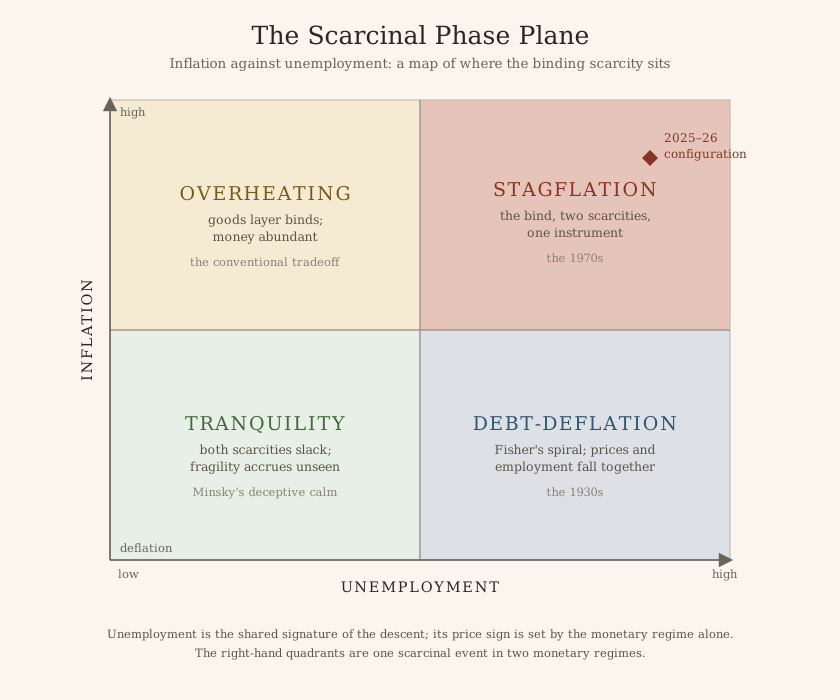
In a depression the shelves stay full. The warehouses are stocked, the factories are intact, the workers are willing, and still people go without. Nothing ran out except the money moving between them. Economics calls itself the science of scarcity but treats scarcity as flat. Scarcinality begins from the opposite premise: scarcities are ranked. In an economy built on money and credit, a shortage of money outranks a shortage of goods, and when money climbs to the top of that order it counterfeits, downward, a shortage of everything it was ever meant to move. Most shortages in a downturn are not real. The real one is sitting one level up.
The claim
The argument has several ancestors. Irving Fisher showed how a scramble for cash drives prices down and debt burdens up, each feeding the other. John Maynard Keynes showed why money becomes the asset everyone wants to hold when the future turns uncertain. Hyman Minsky showed how a long calm quietly builds the fragility that makes the scramble inevitable. And the modern Money View, associated with Perry Mehrling, set out the idea this site leans on most: that money is arranged in a hierarchy, with the most accepted money scarce at the top. Scarcinality does not claim to have discovered these things. It widens that hierarchy of money into a broader ordering of scarcities and gives it a name: the scarcity that binds an economy is not fixed, it moves, and in a credit economy money sits at the top of the order it moves through.
What is here
The full argument, in eleven parts, from the coinage through the phase plane to a worked example of present conditions. Read it on the web or download the typeset edition.
Read ›The treatise walked one step at a time, in plain language. An ordered series that builds the idea from the ground up, ending at the indicators worth watching.
The series ›The theory meets the tape. A running scorecard of the framework's conditional predictions, and recurring readings of where current markets sit on the plane.
Live readings ›The dispatches make conditional predictions and track them in public. A framework that tells you what it expects should be seen sticking its neck out.
Begin: which shortage is real?