The earlier posts described the descent in words. To make it usable we need two more things: a mechanism that shows the descent working step by step, and a surface where we can watch it happen. Irving Fisher gives us the mechanism. A relationship named for the economist A.W. Phillips gives us the surface. The contribution of scarcinality is to notice that these two well-worn ideas are really one phenomenon seen from two sides.
The engine: Fisher's chain
In 1933 Fisher laid out the anatomy of a depression as a chain of nine links, and the order is the whole point, because each link pulls the next. It starts with too much debt. A shock sets off a wave of selling to raise cash. The selling shrinks the supply of money in circulation and slows the rate at which it moves. That drives prices down. Falling prices raise the real weight of the debts, which we met in the post on the counterfeit, so the selling that was meant to relieve the pressure increases it. From there the rest follows in sequence: business net worth falls, bankruptcies spread, profits collapse, output and employment shrink, confidence drains away, people hoard cash and money moves slower still, and interest rates behave perversely, with the stated rate falling while the real rate climbs.
What makes this an engine rather than a list is that it feeds itself. Every borrower's individually sensible rush for cash destroys the prices and incomes that everyone else needs in order to find cash. The harder the system tries to escape, the tighter the trap closes. It is the descent of the master scarcity, rendered as a machine with nine moving parts.
The surface: the Phillips curve
The Phillips curve is one of the most famous pictures in economics. In its simple form it plots inflation against unemployment and reports a tradeoff: push unemployment down and inflation tends to rise; let unemployment climb and inflation tends to fall. For a generation policymakers treated it as a menu, a stable choice between a little more inflation and a little less unemployment.
Then in the 1970s the menu fell apart. Inflation and unemployment rose together, which the tradeoff said could not happen. Economists patched the idea by allowing the curve to shift around with people's expectations of inflation, which was a genuine improvement. But it left a deeper question unanswered. Why does the curve move at all? What is doing the shifting?
Why the surface keeps breaking
Scarcinality's answer is that the Phillips curve was never a self-contained law of the world of goods and jobs. It is a shadow that world casts, and the shadow moves because the surface it falls on is being pushed from above, by whatever money is doing. The curve is not a fixed menu you can order from. It is a screen on which the descent of the master scarcity shows up as motion. Asking for a stable Phillips curve is like asking a shadow to hold still while the object casting it walks across the room.
That reframing is what lets the engine and the surface lock together. Fisher's chain is the thing moving in the dark. The Phillips curve is the shadow on the wall. When you understand that the shadow is driven from the monetary layer above, the curve's whole frustrating history, stable for a while, then suddenly not, stops being a puzzle and becomes exactly what you would expect.
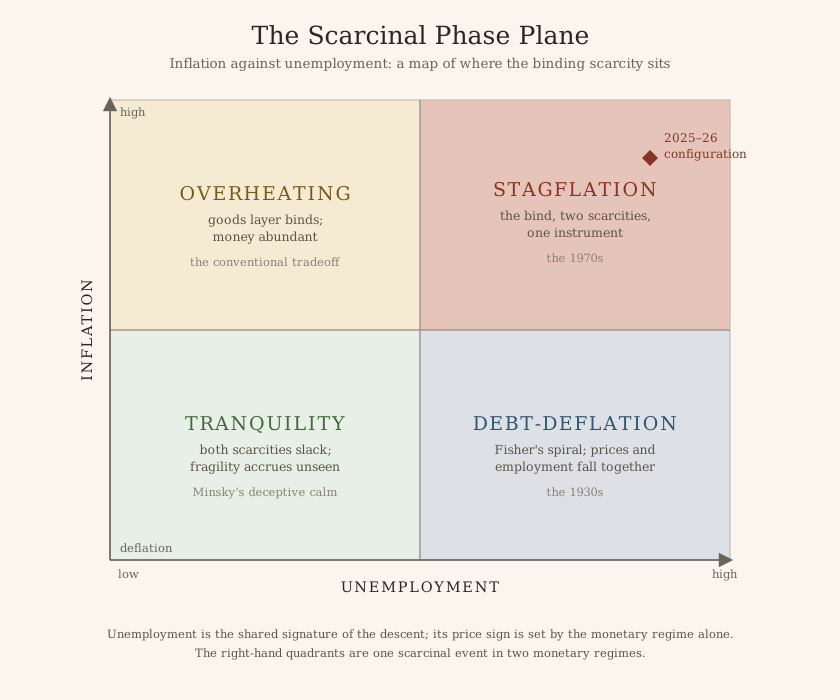
Draw that surface out fully and you get a simple four-cornered map, above. And that map resolves the oldest confusion in this whole area: why deflation and stagflation, which look like opposites, are really the same thing in different clothes. That is the next post.